How many unordered pairs are in a group of six distinct objects?
Core idea
Find an invariant and prove each permitted operation preserves it. For evaporation with fixed dry matter, final mass is initial dry mass divided by the final dry fraction.
An invariant is useful because it removes the need to simulate every intermediate step. Let I(s) be a quantity attached to a state s. If every legal move from s to s satisfies , then every state reachable from the start has the same value of . Compare the proposed endpoint with that value. If it differs, the endpoint is impossible; if it agrees, a construction is still needed.
More practice
Solve these questions here. More practice counts separately from lesson completion.
0 / 10 solved
Apple Matter
Practice
1476Conservation and invariantscoreNew
Jack purchased 100 kilograms of apples, which originally consisted of 93% water and 7% apple matter. After leaving them exposed to sunlight, the water content of the apples reduced to 65%. What is the weight of the apples after the sunlight exposure?
Modeling assumptions: Only water evaporates; dry apple matter is unchanged.
Breaking Chocolate
Practice
1481Conservation and invariantscoreNew
A chocolate bar consists of 50 unit squares arranged in a 5×10 grid. At each break, you must choose one existing connected piece and break it along a straight line from one of its edges to the opposite edge. You may not stack or align separate pieces to break more than one piece at once. What is the minimum number of breaks required to separate the bar into 50 individual squares?
Chips on a Table
Practice
1484Conservation and invariantscoreNew
Suppose 127 chips are placed on the table in front of you. Each chip has one blue and one white side. Out of the 127 chips, 40 are lying blue side up. You are now blindfolded and asked to divide these chips in two groups, with both groups having the same number of chips with the blue side facing up. You are allowed to flip any chips as part of your strategy. How do you proceed?
Fruit Magic
Practice
1237Conservation and invariantscoreNew
An island has 13 red, 15 green, and 17 blue chameleons. Whenever two of different colors meet, both become the third color.
Water and Wine
Practice
1526Conservation and invariantscoreNew
Two jars contain equal volumes of liquid. The first jar has water, and the second jar has wine. If you take a certain amount of water from the first jar and put it in the second jar, and then take the same amount of the mixture from the second jar and put it back into the first jar, which jar has a higher content of the foreign liquid? In other words, is there more water in the wine jar or more wine in the water jar?
Modeling assumptions: Treat volumes as additive, with no liquid lost during either transfer.
Card game
Practice
1213Conservation and invariantscoreNew
From a shuffled 52-card deck, turn over pairs. Black-black pairs go to the dealer, red-red to you, mixed pairs are discarded. You win $100 only if your pile has more cards; ties pay nothing. What is the most a risk-neutral player should pay?
Modeling assumptions: Value the game by its expected monetary payoff.
Last ball
Practice
1221Conservation and invariantscoreNew
A bag starts with 20 blue balls and some red balls. Repeatedly remove two random balls; if colors match insert one blue, otherwise insert one red. What is the final ball’s color?
Coin piles
Practice
1224Conservation and invariantscoreNew
Blindfolded, you face 1000 coins: exactly 20 heads and 980 tails. You cannot feel which side is up but may flip coins. Divide them into two piles with equal numbers of heads.
Split a pile of 1000 coins into two nonempty piles. Add the product of their sizes to a running sum. Repeat on every nonsingleton pile until all piles are single coins.
Chocolate bar problem
Practice
1239Conservation and invariantscoreNew
A 6×8 chocolate bar is broken into its 48 unit squares. Each break divides one existing rectangle into two smaller rectangles. How many breaks are needed?
Found a mistake in this lesson?
′
I(s′)=I(s)
I
Worked example
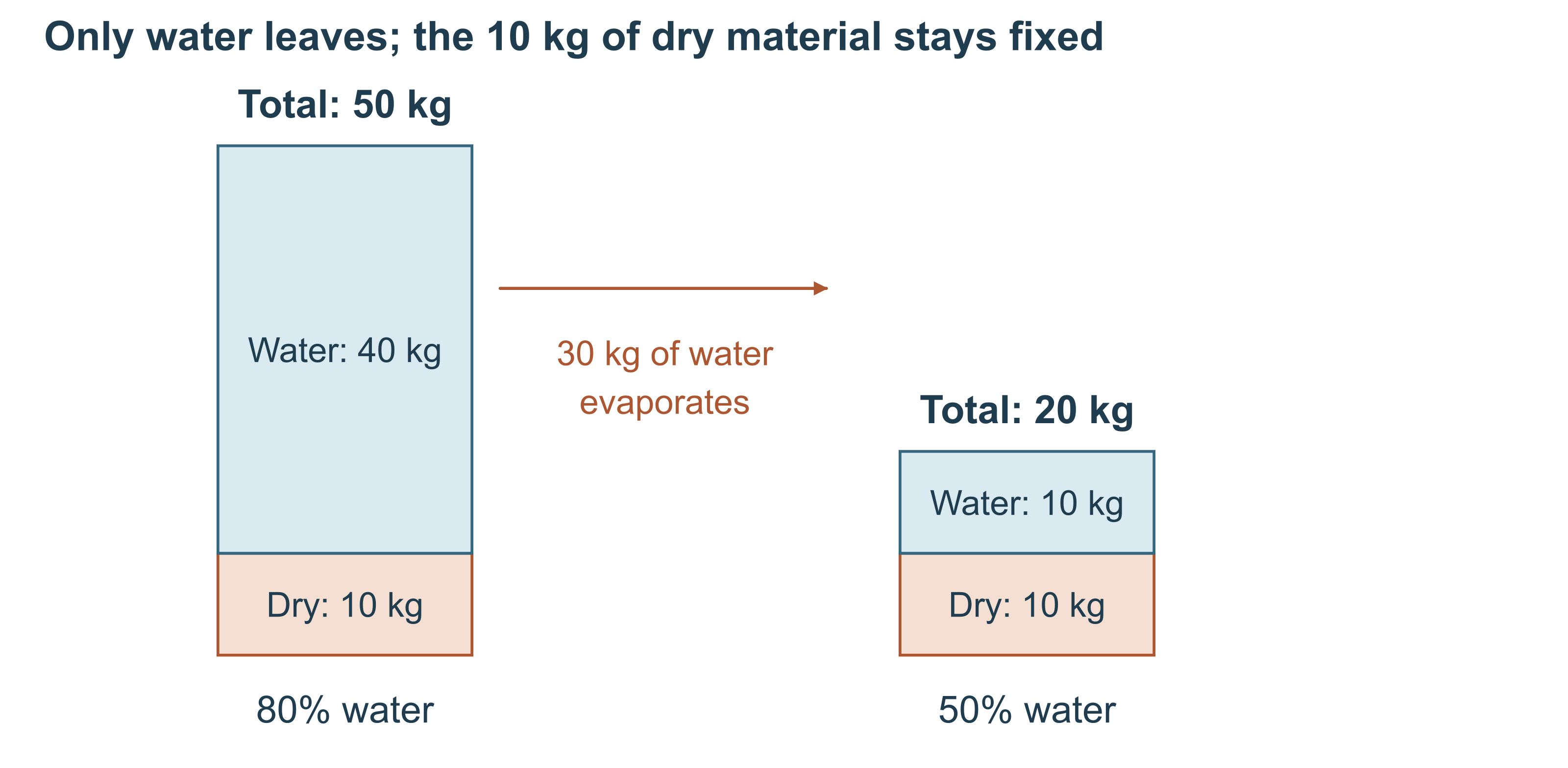
A 50-kilogram material is 80 percent water. After evaporation it is 50 percent water. Find its final mass.
Let M0,M1 be the initial and final masses, and w0,w1 their water fractions. Only water evaporates, so the dry mass is unchanged. Here M0=50 kg, w0=0.80, and w1=0.50. The factors 1−w0 and 1−w1 are dry-material fractions.
M0(1−w0)=M1(1−w1),M1=1−w1M0(1−w
The final mass is 20 kilograms. Initially the dry material weighs 50(0.2)=10 kilograms. That same ten kilograms is now half the total, so total mass is 10/0.5=20. Subtracting percentage points directly from the original mass would not preserve dry matter.
Figure2 Both columns use the same mass scale. Initially 40 kg of water plus 10 kg of dry matter makes 50 kg. At 50% water, the unchanged 10 kg of dry matter must be half the total, so 10 kg of water remains and total mass is 20 kg.
Methods and variations
A. Keep dry mass fixed
If only water evaporates, dry mass is conserved. With initial mass M and water fractions w0,w1, final mass is M(1−w0)/(1−w1); percentage points are not a mass.
Write the conserved quantity before solving for an unknown total:
D=M0(1−w0)=M1(1−w1),M1=1−w1D.
Here D is dry mass and the w values are water fractions, not masses. As evaporation lowers the water fraction, the dry fraction rises, so the same dry mass represents a larger fraction of a smaller total. This gives a direction check before calculating. The denominator must be positive; a body with positive dry mass cannot finish as exactly 100 percent water. If dry material is also removed, this invariant no longer applies.
Practice
03Conservation and invariantscoreNew
A 60 kg crop is 90% water. It dries to 80% water. What is its final mass?
04Conservation and invariantscoreNew
A 40 kg industrial slurry is 25% solid. Removing only liquid raises its solid fraction to 40%. How much slurry remains?
05Conservation and invariantshardNew
A 100 kg crop changes from 99% water to 98% water by evaporation. Is its final mass 99 kg?
B. Compare foreign liquid after equal-volume exchanges
When two vessels finish at their original volumes, any original liquid missing from one is displaced by foreign liquid. If nothing spills or disappears, the two foreign-liquid amounts must be equal.
Call the liquids A and B. Suppose vessel A starts and ends with volume V, and finally contains x units of B. It must then contain V−x units of A, so exactly x units of its original A are missing. If the only other destination is vessel B, that vessel contains exactly x units of A.
The argument uses final volumes and conservation, so it does not need the intermediate mixture to be uniform. Uniform mixing would matter if the task asked for the numerical transferred amount. Spills, evaporation, extra containers or unequal final volumes change the accounting and can invalidate the equality.
Practice
06Conservation and invariantscoreNew
Two vessels initially contain 100 mL of pure water and 100 mL of pure wine. Transfer 10 mL from water to wine, mix, and return 10 mL. Compare the wine now in the water vessel with the water now in the wine vessel.
07Conservation and invariantshardNew
Two vessels initially contain 100 mL of water and 100 mL of wine. Transfer 10 mL of water into the wine, mix, and return only 5 mL. Are the wine in the water vessel and the water in the wine vessel equal?
C. Write the unknown selected count before flipping
With B blue-up chips, choose exactly B chips. If x selected chips show blue, B−x blue chips are unselected and flipping the chosen group makes its B−x white chips blue.
The unknown x is deliberately left symbolic. Selecting B chips creates two matching descriptions:
blue outside=B−x,white inside=B−x.
Flipping swaps the two colors in the chosen group, turning its white count into its blue count. The final blue counts therefore agree for every possible x. No estimate of x, random selection assumption or ability to recognize colors is needed. The trick is to choose the group size so the same unknown appears in both counts and cancels. If a move can fail to flip a chip, the identity no longer proves the result.
Practice
08Conservation and invariantscoreNew
Twelve chips include five blue-up chips. You select five unseen chips and flip them. Show that the two groups have equal blue-up counts.
09Conservation and invariantscoreNew
Thirty coins include nine heads. Without looking, form two piles and flip every coin in one pile so both piles have the same number of heads.
10Conservation and invariantshardNew
With thirty coins and nine heads, would selecting fifteen coins and flipping them guarantee equal heads?
D. Count the change made by each legal split
If each break splits one connected piece into two, the number of pieces rises by one; reaching M pieces from one requires M−1 breaks. Stacking pieces changes the allowed operation.
If a pile of n coins is repeatedly split into piles of sizes a,b and contributes ab, count each unordered pair at the first split separating it. Every pair contributes once, so the total is (2n), regardless of the split sequence.
A useful alternative to following a sequence is to count what each operation contributes. Replacing one piece by two changes the piece count by +1, regardless of shape. After b such breaks the count is 1+b, so reaching M pieces requires b=M−1 under exactly that operation model.
For coin splits, define the potential Φ as the number of pairs still in the same pile. Splitting a pile of size a+b decreases it by
(2a+b)−(2a)−(2b)=ab.
Adding contributions over all splits telescopes: the intermediate potentials cancel, leaving the initial pair count minus the final pair count. Once every pile is a singleton, the latter is zero. This explains why the splitting order cannot change the total.
Practice
11Conservation and invariantscoreNew
A chocolate bar has twenty unit squares. Each break separates one connected piece into two along a grid line. How many breaks yield all twenty squares?
12Conservation and invariantscoreNew
A directory tree starts with one leaf. Every permitted edit replaces one leaf by two leaves. How many edits create seventeen leaves?
13Conservation and invariantshardNew
Split a pile of six coins into single coins. At each split, add the product of the two new pile sizes. Does the total depend on the splitting order, and what is it?
E. Test a remainder or color balance through every transition
When one item of each of two types becomes two of the third, changes are permutations of (−1,−1,2), so pairwise count differences are fixed modulo three. Compare a proposed endpoint with the initial remainders; matching them alone does not construct a route.
Discarding mixed pairs preserves the difference between red and black counts. Replacing a same-color pair by blue and a different-color pair by red preserves red-count parity, so the last ball is red exactly when the initial red count is odd.
For a move (x,y,z)↦(x−1,y−1,z+2), the difference x−y is unchanged and x−z falls by three. All pairwise differences are therefore unchanged modulo three. Check the same fact for every permutation of the move before claiming an invariant.
Color arguments work similarly. Removing one red and one black preserves R−B. Under the stated replacement rule, a red-red pair changes the red count by −2, a blue-blue pair by zero, and a mixed pair by zero after its red replacement. All changes are even. The final red parity is consequently fixed even though the number and arrangement of balls change. An invariant rules out some endpoints without having to enumerate all move sequences.
Practice
14Conservation and invariantscoreNew
A box holds five red and six blue balls. Repeatedly replace two balls by one: same colors give blue, different colors give red. What color must the last ball be?
15Conservation and invariantshardNew
Counts of three types are (2,3,4). An interaction replaces one item of each of two different types by two items of the third. Can all nine become the same type?
Lesson check
16Conservation and invariantscoreNew
There are seven blue-up chips among twenty. Without seeing them, select seven chips and flip all seven. Why do the selected and unselected groups have equal blue-up counts?
17Conservation and invariantscoreNew
A 100-kilogram material is 90 percent water and becomes 80 percent water. Find its final mass if only water is lost.
18Conservation and invariantscoreNew
Each legal break splits exactly one piece into two. How many breaks are required to turn one piece into twelve?
19Conservation and invariantscoreNew
A shuffled packet has eight red and eight black cards. Remove cards two at a time; discard mixed pairs and retain same-color pairs. Can the retained red cards outnumber the retained black cards?